| WEBster Navigation |
| Link |
Description |
| Art of Assembly Book |
The most popular on-line assembly language reference in the world! Join the thousands and thousands of people who've discovered the fastest and easiest way to learn assembly language programming! |
| High Level Assembly
SourceForge Source Code Download Page
Now Available for Mac OSX, FreeBSD, Linux, and Windows!
|
The evolution of assembly language! Now you can write real assembly language programs without all the disadvantages of writing code in assembly language. Now you can write applications in true assembly code as efficiently as writing code in a high-level language. |
| The HLA Standard Library
SourceForge Source Code Download Page
|
The most popular component of the High Level Assembler (HLA) has always been the HLA Standard Library. Check out the brand-new, revamped and improved, version of the HLA Standard Library! |
| Windows Assembly |
Want to learn how to write Windows GUI apps in assembly language? This is the place to learn. NEW! HOWL (HLA Object Windows Library) tutorial is now available on Webster. HOWL is the easiest way ever to write Win32 assembly language programs. |
| Linux Assembly |
Want to learn how to write Linux applications and device drivers in assembly language? This is the place to learn. |
| Write Great Code |
All about Randy Hydes "Write Great Code" series. |
| Software Audio Console |
SAC is a pro audio tool that implements high-quality "Front of House" and "Monitor Mixer" boards on a PC. Here is some software and other information I've written for SAC.
Article on speaker placement (interesting stuff) |
| |
|
| Topic |
Description |
Link |
| OllyDbg |
The OllyDbg debugger is the official debugger for HLA HLA users can use this powerful machine level debugger under Windows to track down problems with their HLA/assembly language programs. |
Download OllyDbg
OllyDbg forum |
| HIDE (HLA IDE) |
Sevag Krikorian is developing the "HLA IDE" (HIDE) system for HLA users. This is the "official" IDE for HLA. |
HIDE Main Page |
| RadASM IDE |
Ketil Olsen's very impressive RadASM package now supports HLA. RadASM is an integrated development environment (IDE) that provides an editor, HLA project manager, keyword completion, syntax/keyword coloring, on-line help and documentation, and much more. This IDE is particularly useful for programmers who use other assemblers in addition to HLA. |
http://radasm.cherrytree.at/radasm/ |
| Art of Assembly/High-Level Assembler Mailing List |
This is the official group on Yahoo intended to support the High Level Assembler and The Art of Assembly Language Programming. Check it out! |
aoaprogramming list |
| MASM32 Support Board |
This is a site dedicated to sharing information about programming in assembly language. Includes an HLA section for HLA programmers. |
http://www.masmforum.com |
| 6502 Assembly Language |
Blast from the Past! See a scanned copy of Randy Hyde's 1981 book "Using 6502 Assembly Language" |
Using 6502... |
| 80x86 Assembly Language |
Paul Carter's Assembly Book |
PC Assembly Language |
| Linux-based assembly |
Jonathan Bartlett's Book on Linux Assembly |
Assembly From the Ground Up |
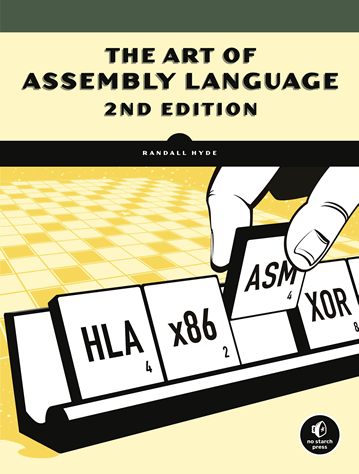
The Easiest Way to Learn Assembly!
Published by No Starch Press (Second Edition is now available!)
(http://www.nostarch.com)
You can order this book from http://www.amazon.com as well as your local bookseller
Click HERE to see a larger version of the cover art.
Now Available!
Write Great Code, Volume I:
Understanding the Machine
Randy Hyde's new series: Write Great Code teaches you everything you need to know to write efficient, readable, maintainable, and quality code.
The first volume in this four-volume set, Understanding the Machine, teaches 'Machine Organization'. Whenever someone tells you that you should learn assembly language in order to learn how to write better high level code, what they're really telling you is to learn machine organization. By reading this book, you can learn how the low-level machine operates so that you can write better high-level language code, without the drudgery of mastering assembly language.
This book will also make a great companion/prerequisite text to "The Art of Assembly Language"
Click Here for more information about the Write Great Code series
Click HERE to see a larger version of the cover art.
Now Available!
Write Great Code, Volume II:
Thinking Low-Level, Writing High-Level
Compiler writers have often claimed that their compilers generate code that is just as good as hand-written assembly language. In practice, compilers rarely achieve this level because of the poor-quality high-level language source code fed to these compilers. Thinking Low-Level, Writing High-Level will teach you how to help your high-level language compiler live up to its promise. This book explains how compilers generate machine code from high-level language statements, so that you can choose the most appropriate high-level statements to efficiently solve the problem at hand.
Click Here for more information about the Write Great Code series
Click HERE to see a larger version of the cover art.
|